 CYGURU
In photographs 1 photograph
Documented photographs from different dates. Open an image to browse the gallery and its original source.
 Enlarge photo ↗

In this guide · 9 sections
Begin with the complete island journey
Delos rewards a visit planned around the entire excursion. Before choosing individual monuments, establish how you will reach the departure point, cross to the island and return. A map showing the archaeological site does not resolve those three stages. Keep the confirmed return arrangement accessible throughout the visit.
Choose the sailing first, then work out the usable time ashore. Leave margin for disembarkation, orientation and reaching the return meeting point. Avoid building a route around every photograph in a guide: the appropriate route is the one that fits the actual crossing and your group’s pace.
Read a sanctuary and a trading place together
Hellenic Heritage describes Delos as both a religious centre and a commercial port, with communities and religious traditions from across the Mediterranean. The sanctuary of Apollo and the residential remains offer different perspectives on that history. Use the visitor plan to relate sacred areas to the wider settlement.
Make the distinction visible in your own observations. Compare the arrangement of a monumental space with the scale of a domestic area. Ask what the surviving remains reveal about movement, gathering and privacy, while keeping clear which interpretations come from the site labels rather than your own impressions.
Look beyond the familiar lions
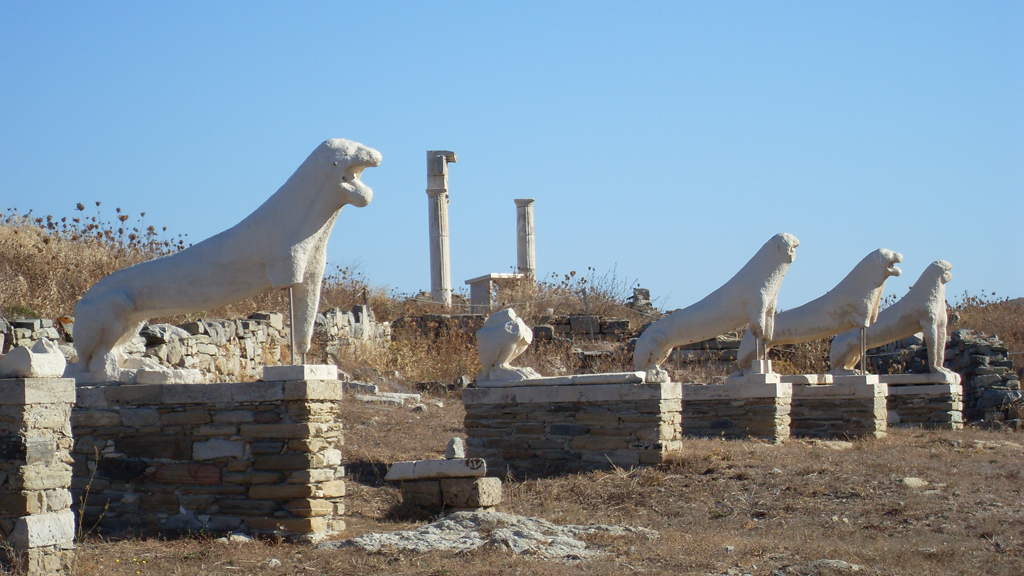
The lions displayed outdoors are copies; the originals are kept in the Archaeological Museum of Delos. This distinction makes the terrace a useful place to think about preservation as well as ancient display. Observe the relationship between the sculptures, the route and the surrounding space before taking a close photograph.
The image accompanying this guide is a historical view from 2008. It illustrates the terrace rather than the current condition of every path or monument. Follow today’s barriers and directions, and do not leave the permitted route to recreate a camera angle from an older photograph.
Give the residential remains time
The official presentation also highlights the Theatre district and mosaic-decorated houses. Where access permits, compare open and enclosed spaces using the plan. Looking at the relationship between rooms often explains more than collecting a photograph of each named feature without understanding how the pieces fit together.
Select one area to examine slowly. Read the interpretation, identify what you can actually see, then check how much of the original setting is missing. Treat reconstructions as explanations of evidence rather than as photographs of the ancient city. Do not assume that every named house will be accessible on your date.
Check the seasonal boundary before booking
The official timetable reviewed on 14 November 2026 lists November opening as 08:00–16:00 and closure from 1 December to 31 March. Last admission is twenty minutes before closing. Recheck the current notices for your travel date: this seasonal boundary is more consequential than choosing a preferred hour.
Site admission and maritime transport require separate confirmation. Check precisely what your excursion purchase includes, its cancellation terms and the arrangements if a sailing changes. A valid attraction ticket does not by itself establish that a boat will operate or that your preferred return is available.
Build a route around the return
At arrival, confirm the meeting point and return instructions before walking away. Decide which part of the visit matters most, and set a personal turn-back point that leaves a comfortable buffer. Do not use the published site closing time as a substitute for the return time of your particular boat.
Check the forecast and ask the transport operator about conditions. Carry appropriate water, footwear and protection for the weather. If mobility or boarding is a concern, ask separately about the boat and the archaeological route; an answer about one stage does not establish accessibility for the entire excursion.
Keep Mykonos as a distinct visit
The Archaeological Museum of Mykonos provides another way to explore the neighbouring islands through objects and their contexts. It is a separate museum from the one on Delos, with its own location and opening arrangements. Check both names carefully when making reservations or sharing a meeting point.
Consider placing the Mykonos museum on a different day so the boat excursion can breathe. Finish Delos with a few clear observations about sacred space, domestic life and the island’s setting. A focused route with a dependable return is preferable to a long list completed under mounting time pressure.
Plan the actual visit
Check opening, admission, access needs and the correct entrance with the official visitor source. Historical photographs do not establish current conditions.
Visitor information ↗Find on a map ↗