 CYGURU
In photographs 3 Photographs
Documented photographs from different dates. Open an image to browse the gallery and its original source.
 Enlarge photo ↗

 Enlarge photo ↗

 Enlarge photo ↗

Official public courtyards and traboules ↗
In this guide · 6 sections
Three neighbourhoods along the Saône
Vieux Lyon lies between Fourvière hill and the Saône. The tourism office describes three connected neighbourhoods: Saint-Georges to the south, Saint-Jean in the middle and Saint-Paul to the north. Their streets, courtyards and galleries give the visit more structure than a single landmark stop.
Editorial approach: choose one neighbourhood to explore slowly, then extend the walk if energy and time allow. Compare river-facing façades with the smaller spaces behind them; changes of scale are part of what makes this district rewarding.
Understand what a traboule is
Traboules are passages through buildings and courtyards that link streets. The tourism office publishes examples open to visitors, including the Longue Traboule between rue Saint-Jean and rue du Bœuf. Consult that official list rather than assuming that every doorway provides public access.
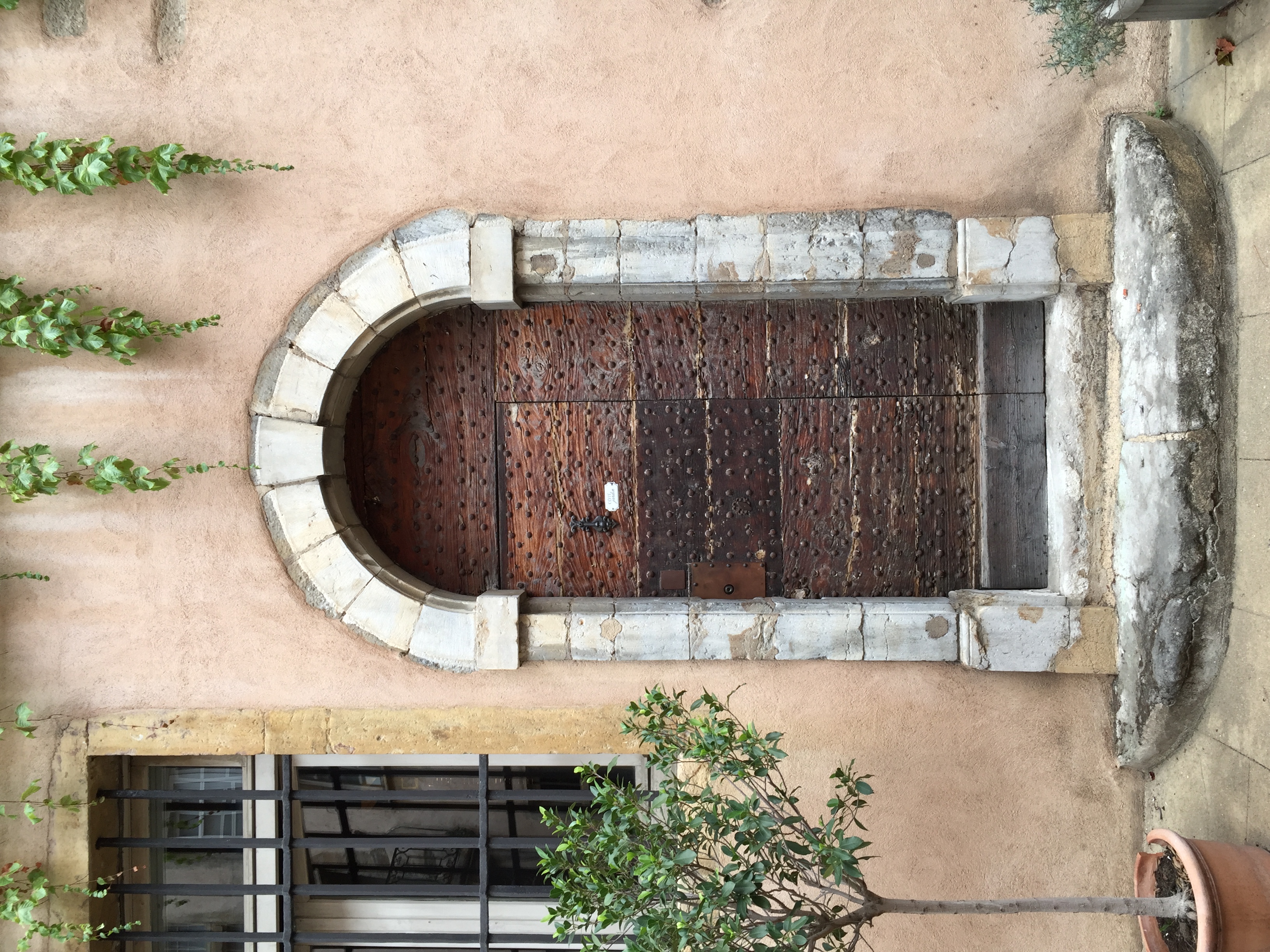
These are also lived-in spaces. Follow signs, wait when a passage is crowded and keep voices low. A closed door should not be treated as an obstacle to overcome, and the historic doorway shown in the gallery is not an instruction to enter that property.
Look closely at the architecture
Editorial viewing suggestion: spend time with one courtyard, one staircase or gallery and one street frontage. Notice how the spaces connect before moving on to the next photograph. Architectural details can be more memorable when understood within their surrounding streets.
The gallery combines a wider district view, an earlier courtyard photograph and a doorway on rue du Bœuf. The images provide architectural context; they do not identify a continuous visitor circuit or establish today’s opening arrangements.
Plan for paving and the hill
The official district guide draws attention to paved streets. Choose footwear and a route appropriate to your party, and ask about the specific passage or building if step-free access is needed. A general city map cannot assess every courtyard threshold.
Fourvière is a separate hilltop visit. Plan the actual connection and return before combining it with the old town, rather than interpreting their visual proximity as a flat or uniformly accessible walk.
Plan the actual visit
Check opening, admission, access needs and the correct entrance with the official visitor source. Historical photographs do not establish current conditions.
Visitor information ↗Find on a map ↗